Showing posts with label 1949. Show all posts

Sunday, May 17, 2020

Strange Bargain (1949)

The salary of assistant bookkeeper Sam Wilson (Jeffrey Lynn) isn't enough to pay the bills for his family, so his wife Georgia (Martha Scott) pushes him to ask for a raise. Instead his boss Malcolm Jarvis (Richard Gaines, Fred MacMurrary's boss on 'Double Indemnity') fires him, as the company's been making a loss for quite some time already. Jarvis himself is also broke, but he has a plan. And for that plan to work, he needs Wilson, so he has a proposition for him... Jarvis intends to kill himself so his family can collect his life insurance policy, but that won't happen if his death is ruled a suicide. So he needs Wilson to make it look like a murder, and he will give him $10,000 in exchange for helping him. Wilson declines, but later that evening Jarvis forces his hand by announcing he's going through with his plan. Wilson rushes over to the Jarvis mansion to dissuade him from it, but he's too late. Jarvis is dead on the floor with a gun in his hand... and an envelope containing $10,000 with Wilson's name on it on the desk. Wilson reluctantly does his part, shoots the gun a few more times and gets rid of it. He hides the $10,000 at home, unsure of what he should do... The new boss, and former adversary of Jarvis within the company, Timothy Hearne (Henry O'Neill) gives Wilson his job back, with a promotion and a hefty pay raise even, and his family thinks all is well again... But Wilson's already conflicted mind gets even more conflicted when police lieutenant Webb (Harry Morgan) views Hearne as the prime suspect for Jarvis's murder...

While Martha Scott is the top-billed name on the movie's poster, her role in this movie is fairly minimal. Scott made a big entrance into Hollywood with her first movie, 1940's 'Our Town', which landed her an Oscar nomination. Her star didn't shine bright for too long however, but apparently bright enough for RKO to bill her over the principal actor of he movie, Jeffrey Lynn. She is decent enough but given she doesn't have to do much here, I wouldn't expect anything less, hah...

I wasn't very familiar with Jeffrey Lynn ('Whiplash', 'The Roaring Twenties') and this movie didn't exactly peak my interest either. In a way his performance is perfect for the character he's playing, as it's meek, unremarkable and bland, but if that's all there is to it... Lynn reminded me here of another everyman actor I find bland, Macdonald Carey... Actors who might do a great job, but the second the movie's over you've forgotten about the part already. And given he's the principal character in this movie, that's not a good sign! Sorry to all the Jeffrey Lynn and/or Macdonald Carey fans out there!

Harry Morgan is the name I was most familiar with, as he's got quite the noir resume. He played in films such as 'Moonrise', 'Appointment With Danger' and 'Dark City'. But he's probably most famous for playing Bill Gannon on the late 60's version of the iconic TV series 'Dragnet'. He plays a limp police officer here, who's cane is quite helpful in the movie's climax. Morgan could play these type of tough police officer serious in his sleep, it's always a pleasure to see his face pop up.

When you see the family's son, you'd be forgiven to think it's Billy Chapin who played the kid in 'The Night Of The Hunter'. In fact, it isn't him but his older brother Michael Chapin. The resemblance is uncanny however. And if I'm being honest, based on these 2 movies, Michael was the better (kid) actor between the two them. His character idolizes Webb, making Sam even more uncomfortable whenever Jarvis's death is brought up around the dinner table, as the son reminds him how good of a detective Webb is. It's a nice touch to the movie.

Visually there isn't a lot noirness going on here. The plot is pretty noir for the first half of the movie, but it wraps things too neatly and happily for Sam Wilson at the end... I can't say I was surprised, or even all that disappointed. The movie does move at a nice pace, and it does twist and turn a bit. It's a solid but very minor film noir.

While I doubt many people who saw this movie at the time will remember it, this movie does have a genuine claim to fame. In the season 3 episode 'The Days Dwindle Down' of the iconic TV series 'Murder, She Wrote', 3 of the principal actors of the movie (Jeffrey Lyn, Martha Scott and Harry Morgan) reprise their roles. While the episode retains the basic premise of the movie, and also uses footage from the movie as flashbacks, it does not use the movie's ending. Instead Wilson ended up taking the rap, spending 30 years in prison. And now that he's out, his wife asks Jessica Fletcher to find out what really happened to Jarvis and to finally clear Wilson's name. As with most MSW episodes, it's a lovely episode and using 'Strange Bargain' as well as several of its actors as an integral part of the episode really makes this a standout episode. I highly recommend it!

7-/10

Sunday, May 10, 2020

Post Office Investigator (1949)

By the time the 50s were arriving, Poverty Row studios were cranking out 'federal investigator' type movies like clockwork. Most of them can be easily recognized by their title, such as 'Federal Agent At Large' which I reviewed here, 'Customs Agent', 'Insurance Investigator', 'Secret Service Investigator' and 'Western Pacific Agent', all made between 1948 and 1951. Republic probably made the most of these movies, and on average also the best. The previously mentioned and reviewed 'Federal Agent At Large' wasn't one of the better ones, but this one is a good example of why these movies can be a lot of fun.

The movie starts with the following message, which in tone was no different than how a lot of these other movies start out, but somehow it's more comical... You decide:
Stamp collecting is the international hobby of an estimated fifteen million people. Small boys and millionaires pursue it with equal zest, finding in it pleasure, education, and a form of savings.

Collectors, with millions of dollars invested in their hobby, are ever on the lookout for rare and priceless stamps... and so, sometimes, are criminals.
In this case, the criminal is George Zelger (Marcel Journet) who poses as a wealthy stamp collector. He is in cahoots with auction house employee Clara Kelso (Audrey Long) to steal an expensive stamp during an auction. The idea is simple, Clara switches the stamp with a forgery and Zelger's associate mails the real stamp to Zelger's home address. However, Clara's boyfriend has an even better idea, what if they steal the letter before it is picked up by the mailmen, and sell the stamp themselves? That way they can get all the money for themselves rather than only a small cut. So Clara convinces the mailmen collecting the mail to give her back the letter. One of the mailmen, Bill Mannerson (Warren Douglas) tries to get a date with Clara, and she gives him a phoney address. When the police figure out mailing the stamp would be the best way to get it out of the building unnoticed they interrogate the mailmen. Knowing they would lose their job or worse if they explain they gave the letter back, which is against postal regulations, they lie. Instead they decide to check out the address Clara gave for their date and there they find secretary April Shaughnessy (Jeff Donnell). A casual remark by April makes Bill remember the mailing address of the letter they gave back, and they head to Zelger's address who is beginning to suspect Clara double-crossed him...

The movie's plot is more intricate than most of these movies, which tend to be a bit crude plot-wise. Here however, the double-cross Clara pulls off adds some tension and intrigue to the movie. It makes things slightly more complicated with more separate parties involved, and as a result, the movie focuses less, or really hardly at all, on the federal aspect of the investigation, but on Bill, Clara and Zegler. It's a minor thing but it works really well for this movie. It does make the admittedly top-notch poster feel a bit weird however. The toughguy on the left is meant to portray one of the agents investigating the case, but he plays only a minor role in the movie. I can agree with the artist however that his face is far more interesting and rugged than Warren Douglas', but it's Douglas who's the main actor here together with Audrey Long, who is the dame holding the gun in the poster.

Neither Warren Douglas nor Audrey Long are household names, and in the case of Douglas that makes sense. Douglas is too light-weight and milquetoast to be a proper noir leading man, but his casual, inoffensive acting is good enough for these noir-light crime movies. Douglas had a long but unremarkable acting career, but as of 1950 he also found steady work as a screenwriter, both for movies such as the noir 'Cry Vengeance' which he co-wrote and also played a part in, and for TV series such as 'Bonanza'. Audrey Long on the other hand had what it takes to be a noir dame, and she had had her chance already, first in the Lawrence Tierney classic 'Born To Kill', and then co-starring opposite Steve Brodie in 'Desperate', an underrated noir directed by the great Anthony Mann. Her career never really took off tho, and she was stuck playing in B-movies.

But the face that is most familiar to the casual viewer will likely be that of Jeff Donnell, who played one of Humphrey Bogart's friends in the classic noir 'In A Lonely Place' from 1950. Born Jean Marie Donnell, she gave herself the nickname Jeff, and it stuck. She steals every scene she is in with her bumbling and infectious acting. She's got a bit of a 'girl next door' quality to her and looks like she could be Gloria Grahame's more wholesome sister. The two were actually friends in real life, but unlike Grahame and like Long, her career unfortunately never really took off and she was a supporting actress for most of her career.

It should come as no surprise that this movie zips by, it is just shy of an hour long. Director George Blair and director of photography John MacBurnie also worked on the aforementioned 'Fderal Agent At Large' as well as a boatload of other movies. Their professionalism shines through here as well, if you just remember that on Poverty Row professionalism equates to 'getting things done as quickly and as cheaply as possible'. Which is not a bad thing if you're into these no/low budget crime movies like I am! They even manage to make the nighttime scenes, especially those happening inside cars, look pretty noir with a lot of shadows and blocked out parts. The best shot of the movie comes when April is following Clara around after accidentally bumping into her and they're inside a metro station. April keeps an eye on Clara via her make-up mirror, which is visualized quite nicely.

This is not a hidden gem. But it is entertaining and fast-paced, which is not a bad thing. It is a typically well-made, unremarkable but also inoffensive, noir-ish crime movie which came a dime a dozen. And in this case, it's above average. If you have an hour or so to waste, you could do a lot worse than watching this movie.

6+/10


Thursday, August 20, 2015

The Threat (1949)

When it comes to film noir from the classic period, no studio did it at such a consistently high level as RKO in my opinion. They were cranking out a lot of great crime thrillers that would retrospectively be called noirs. While Howard Hughes had acquired RKO in 1948 and was just beginning to slowly run the studio into the ground, 1949 saw the release of 'The Threat', based on a story by Hugh King, who also produced this movie. King would also co-write the story for another great noir, 1950's 'Dial 1119'. The movie was directed by Felix Feist ('The Man Who Cheated Himself'), with cinematography by Harry J. Wild ('Murder, My Sweet', 'Pitfall') and music by Paul Sawtell who composed (mostly stock) music used in literally hundreds of movies. Anyways...

Charles McGraw is escaped convict Arnold 'Red' Kluger, who has 2 things on his mind: get his hands on the money from the last robbery he did and get even with the people he holds responsible for him doing time in Folsom. To that end he kidnaps police detective Ray Williams (Michael O'Shea) and D.A. MacDonald (Frank Conroy), who captured him and sent him to prison, and his former gunmoll Carol (Virginia Grey) whom he suspects ratted him out to the police. Together with fellow escapees Nick Damon (Anthony Caruso) and Lefty (Frank Richards) they drive to an abandoned shack in the desert with innocent truck driver Joe (Don McGuire) and his moving truck. There they wait for Kluger's partner to take him to Mexico and his money. Meanwhile the manhunt for Kluger is led by inspector Murphy (Robert Shayne), who believes Williams went undercover to find Kluger..
I'm headed for that gas chamber anyway, you two won't even count.
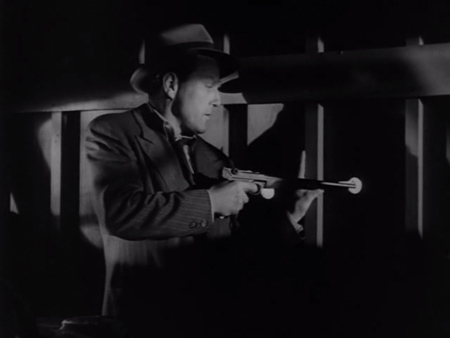
While not top-billed, and not yet a household name, the real star of the movie is without a doubt Charles McGraw. After a string of smaller parts, including a memorable part as one of the eponymous killers in 1946's 'The Killers', this movie proved to be his break-out role. It landed him a long-term contract at RKO where his next movie would be another great noir, 1950's 'Armed Car Robbery' (guess what that one's about...). As 'Red' Kluger, McGraw shows his intensity, charisma and screen presence. The man's chiseled face with his gruff voice were a perfect match for film noir. He also carries an impressive gun with an impossibly long barrel here, as can be seen in the poster as well as the screenshot below. Does anybody know the make and model of this gun? I'm curious...


As is often the case in a 'squeaky good guy versus vicious bad guy' movie, the bad guy is the one who's fascinating to watch. And McGraw, no matter what role he played, was fascinating to watch. One of noir's toughest tough guys. Director Felix Feist directed another genuine tough guy a few years earlier in another noir, Lawrence Tierney in 1947's 'The Devil Thumbs A Ride'. But while Tierney was probably the bigger (and definitely more notorious) tough guy in real life, McGraw was the better actor. And he's excellent here, elevating this movie to a higher level. He exudes menace and ruthlessness from every pore of his (in this movie extremely sweaty) body, whether it's by calmly threatening people or by getting truly violent. The few times McGraw gets violent, the camera focuses squarely on him, showing his pent-up intensity as he shoots somebody or, in the most violent scene, slams a wooden chair to bits and pieces over O'Shea whom he has pinned down on the floor.

Top-billed Michael O'Shea does a decent enough job, but to me he is not noir-material. He also appears in a few other (low budget) noirs, like 'Mr. District Attorney' (1947) and 'Parole, Inc.' (1948), but his face is far too friendly. Maybe the studios didn't know what to do with him, he never seemed to find his niche in Hollywood. But to be honest, O'Shea isn't an actor you watch a movie for, especially not something as dark as a film noir. To me he's miscast here, I cannot see how O'Shea could ever be a police detective, let alone an undercover one. Virginia Grey ('Highway 301', 'Strangers In The Night') on the other hand is great here as the gun moll. She is both desperate and seductive, and plays her part very effectively.


The movie plays out in 2 parts. The first part introduces the characters and is fast-paced. The second part starts when they get to the cabin and while the pace slows down, the tension only increases in the sweltering heat. Feist and Wild do a great job at balancing the movies parts together in a cohesive and natural manner, with a smooth but very tight flow. Also visually they keep a tight reign on things, with some excellent and clever shots, camera angles and shadows to keep things interesting.

The plot is pretty straight-forward but it does have some nice touches to it. At one point Williams, forced at gunpoint by Kruger, calls inspector Murphy over police radio to have them search in the wrong direction. He ends with a message for his wife and unborn son, using the one name he would only give his son with a gun to his back, hoping she'll catch it and inform the police. But she doesn't pick up on it until much later in the movie!


'The Threat' is a solid lean and mean slice of film noir with a lot of tension and hardly a wasted frame of film. It doesn't have a real femme fatale (altho Carol turns out to be a lethal lady), and the leading guy is nowhere near as cool as Sam Spade or Philip Marlowe. But it has Charles McGraw. And any crime movie with Charles McGraw is worth watching, take my word for it.

8/10

Fun piece of trivia: while O'Shea starred opposite McGraw in this movie which jumpstarted McGraw's career, O'Shea's wife Virginia Mayo starred opposite another silver screen tough guy, James Cagney, in 'White Heat' (also 1949) which reinvigorated his career after abandoning his gangster movies from the late 30s.

Sunday, June 21, 2015

"C"-Man (1949)

Film noir is almost by definition a style that suited the low-budget poverty row studios. It allowed for cheap sets, low-key lighting and does away with glamour. A shadow-filled world for shady characters living in seedy apartments. 1949's '"C"-Man' is an excellent example, as it's clearly a low-budget movie yet it manages to rise above its low expectations and deliver a great noir. This movie shows how a lack of budget does not mean a movie is not deserving of more attention. In fact, I'd say '"C"-Man' is kind of a hidden gem. It was the first of 3 movies produced by the short-lived Laurel Films production company, the next would be the Zachary Scott noir 'Guilty Bystander', and finally a wrestling comedy called 'Mister Universe'

Dean Jagger plays Cliff Holden, a customs agent, or "C"-man, working for the U.S. Treasury Department. His new assignment is to take over a case previously worked on by his best friend, who got killed because of it. It revolves around the theft of a valuable necklace belonging to Lydia Brundage (Edith Atwater), somewhere in France. The only lead they have is Matthew Roy (Rene Paul), who is flying back to the States soon and who they expect will smuggle the necklace back into the States. Holden is to fly to France and catch the same flight back. While waiting at the French airport, he meets Kathy Von Bourne (Lottie Elwes) who is flying to the U.S. to marry her war-time love. But on the plane Kathy is drugged by Doc Spencer (John Carradine), planting the necklace on her underneath bandages he wraps on her head, so it can be smuggled past customs. As both Holden and Kathy quickly find out Roy and his gang, including a crazy Owney Shor (Harry Landers), will literally kill for the necklace.

The movie starts off thanking people from the Treasury Department without whose help this movie apparently could not have been made. I suspect the title card was inserted to add some sort of credibility to the movie, because nothing from the sets to the story itself really point to something that required official government help.


I'm not really familiar with Dean Jagger. In this movie he seems to be channeling Dick Powell's Philip Marlowe from 'Murder, My Sweet' mostly, coming off as a second-rate version in the process. He's adequate, good even, but in terms of noir actors, he's no Powell. He would win a best supporting actor Oscar for the psychological WWII drama 'Twelve O'Clock High' the same year, but he's not as suited for this sort of darker, more cynical material as Powell turned out to be. Despite appearing in a few more noirs like 'Private Hell 36', film noir simply wasn't Jagger's best match.

Lottie Elwen was a really nice surprise, her portrayal of the Dutch Kathe van Bourne is pretty good and engaging. But according to IMDb this was her only on-screen appearance, I have no idea what happened to her, was she perhaps primarily a stage actress? In any case, it's a real shame, she had talent. Legendary character actor John Carradine, often cited as having more acting credits on IMDb than anybody else at close to 350, makes the most of his limited screen time. His alcoholic Doc Spencer is a minor character in the movie despite Carradine being billed second, but he leaves quite an impression. The same can be said for Harry Landers ('Guilty Bystander', 'Drive A Crooked Road') as the vicious and volatile Owny. He does a good job, altho he does ham it up a bit, sometimes a more restrained performance can exude more menace than a crazy one. The rest of the cast are good too, giving fairly solid performances, which help elevate the movie.

Besides the solid acting lifting this movie out from the bottom-scraping level, there are additional factors that elevate this flick. There is an unusual high amount of location shooting on the seedy streets of New York City. And it works really well here, it gives a great impression of NYC, not just in the scenes where Holden is walking across the city looking up all the liquor stores in search for information that will lead him to Doc Spencer, but also stock footage of people rushing around the Staten Island ferry terminal and such.


And then there's the music, composed and conducted by Gail Kubik. It is pretty unique and sounds way more modern than late 40s. A few years later he would win the prestigious Pulitzer Prize for his overall work. His score here plays throughout a large part of the movie, in some places it's almost a quiet muzak-like tune, but it is still there. But during key scenes his music adds a weird vibe and also provides almost horror-like sound effects, most noticably during the brutal beating of Doc Spencer by Owny. He's also responsible for the song that is played in a jazz club, which again sounds like something you'd hear in a mid to late 50s movie, not a late 40s movie.

Both director Joseph Lerner and cinematographer Gerald Hirschfeld started out with this movie, and also worked on the other 2 Laurel Films movies. Lerner's career fizzled out rather quickly but Hirschfeld stayed behind the camera well into the 90s! They both do great jobs here actually, if one manages to look through the beat up, washed out public domain print that is available online. The script by Berne Giler, who would write mostly for TV shows, is not exactly remarkable in any way, it's straight-forward and with decent but not very exciting dialogue that is clearly inspired by far better movies. But on the flipside, it means it's got a nice noir sensibility to it, that will appeal to noir lovers.

'"C"-man' is a low-budget noir and it shows. It also lacks any real star-power, an original story or anything really surprising. However, its sum is bigger than its parts. The movie as a whole, judged as film noir, works far better than expected. It rises above what it should be, and that is always a good thing. In fact, this to me is worthy to be called a hidden gem. If you love film noir, you need to check out this movie. If you're not into film noir however aside from 'the classics', this might not be your new favorite.

8/10

Sunday, June 8, 2014

The Set-Up (1949)

A while ago a friend asked me about boxing and film noir. My initial response was that it didn't really have a connection outside of a few noirs like 'Body And Soul' and 'Champion'. However, the more I thought about it, the more movies kept popping up. Noirs that feature (ex-)boxers as a main character such as 'Killer's Kiss', 'The Killers' and '99 River Street', or noirs that revolve around the boxing ring such as Bogart's last movie, 'The Harder They Fall'. In terms of noirs whose main focus is boxing, 1949's 'The Set-Up' seems to garner less attention and acclaim than the aforementioned 'Body And Soul' and 'Champion', but it is a real classic in my book.

'The Set-Up' has a pretty basic plot with no real surprises, but it still manages to pack a punch and hide a few tricks up its sleeve. Bill 'Stoker' Thompson (Robert Ryan) is a boxer with a 20-year career who's well past his prime. His latest fight is against up-and-coming talent Tiger Nelson (Hal Baylor). Local promotor and gambler Little Boy (Alan Baxter) wants Nelson to win, and has paid off Stoker's manager Tiny (George Tobias) and trainer Red (Percy Helton) to have Stoker take a dive in the 3rd round. But Tiny doesn't want to tell this to Stoker as he figures Nelson will win easily anyways, so he won't have to pay Stoker his share. Stoker however feels he can take this new kid on the block. All it takes is one shot...

It is good to remember that this movie is from 1949, movies like 'Raging Bull' and 'Rocky' hadn't been made yet. Yes, Stoker does win, that should not come as a real surprise, but no, this does not mean there's a happy ending. The arena is a seedy place, the fights are for handouts, not for titles. The audience will cheer on whoever's got the upper hand in a fight, all they care about is getting their money's worth in blood, sweat and tears. After Stoker wins, the hall clears out instantly, there are no celebrations, no heroics. Hell, Stoker's fight isn't even the main bout of the evening, the main fight's pushed to an earlier spot due to the local radio station's schedule. Only the fighters themselves care, and Little Boy. Little Boy cares... It's not even about Stoker beating Tiger Nelson, it's about Stoker not doing what he's told, even if nobody told him what to do. Stoker has no control over his fate and doesn't realize it, and when he finally does, he still makes the wrong choice. That's noir.
Stoker! Stoker! Kill him! Kill him!
The main trick played on the audience is that the movie takes place in real time. Lasting 72 minutes, the whole story plays out from roughly 9.10pm to 10.22pm. This was, and still is, a rarely used device, but it works remarkably well here. The movie starts out before the fight, alternating between the locker room and Julie (Audrey Totter), Stoker's wife, then shows the fight itself, and finally it focuses on the aftermath. And unlike most boxing movies where the underdog beats all the odds and wins, Stoker's win will also prove to be his undoing.


The scenes in the lockerroom are magnificent, and have a very touching side to them. Even though most of the fighters that night are either washed up like Stoker, or just starting out, they all share the same dreams of becoming a world champion. But they're not alike, all fighters have distinct personalities in this movie. If Stoker is washed up, 'Gunboat' Thompson (David Clarke) is all dried up with too many losses behind his name to keep count of. He keeps talking about Frankie Manilla, a fighter who had a losing streak of 21 losses but still managed to become middleweight world-champion. When Gunboat is carried back into the lockerroom all beat up after yet another loss, the doctor checks up on him and asks him who he is. Gunboat mumbles 'Frankie Manilla. I am Frankie Manilla.' It's a very intense and profound moment that explains this movie better than anything else. But the lockerroom scenes also show the comradery between the fighters, how everybody's on equal footing. Nobody pays any attention to fellow boxer Luther Hawkins's skin color inside the lockerroom, played by James Edwards, until his manager comes to pick him up for his fight and calls him 'boy'.

On the other end of the first act of the movie is Julie's story, played by one of the true dames of noir, Audrey Totter. In this movie however, she's anything but a femme fatale, but a demure and loving wife who's worried about her husband's health. She can't even bear to see him fight anymore, and so she wanders around the aptly named Paradise City before and during the fight. There is a great scene on an overpass overlooking the traffic where Totter shows she could really act with her face, showing her inner struggles. But all in all, her role is fairly wasted, and Totter is not the right actress for this kind of part, some of the lines she speaks come out in an over-the-top melodramatic kind of way, as if she didn't really know how to play Julie. It's a shame because Totter is one of my favorite ladies of noir.


Robert Ryan however was made to play these kinds of complex, world-weary, tortured souls. His performance here is truly great. You can see in his eyes and his body that he knows he's over and done with, that he's reached the end of his career, but you can also see that he still has his dreams, that he truly believes he can win against Tiger Nelson and that he's only one fight away from a shot at the title. The poem the movie was based on, Joseph Moncure March's 'The Set-Up' was about a black boxer, but according to director Robert Wise there was no black actor under contract with RKO at the time who fit the boxer profile. Ryan had been a heavyweight champion during his college years and was still in great shape (so great in fact that he had to really work to fight with a scrappy, stumbling style that an over-the-hill fighter like Stoker Thompson would have), so he was the natural choice for the part.
There's no percentage in smartening up a chump.
The fight, which takes up roughly 20+ minutes of the movie, is shown from start to finish, every second of it, and it's quite the slugfest. Johnny Indrisano was hired as a consultant for the fight, a retired pro-boxer. It also didn't hurt that not just Ryan but also Hal Baylor (still working under his first acting name here, Hal Fieberling) had extensive boxing experience. Baylor was a recently retired pro-boxer with a 15-8-2 career (and close to 60 amateur fights). All that experience makes the fight painful to watch because they really do slug it out. Because of them really going for it with constant barrages of hits, the fight does become unrealistic as well, because in reality somebody would've gone down way quicker. But that minor quibble aside, it's a really gritty and brutal fight to watch.


Robert Wise ('Odds Against Tomorrow', but also 'The Sound Of Music'!) directed the movie, which was based on a screenplay by Art Cohn, based on the aforementioned poem. Milton Krasner ('No Way Out', 'House Of Strangers') did the cinematography which really shines during the third part of the movie with the aftermath of the fight, which sees Stoker's last shred of a boxing career destroyed by Little Boy and, ironically, Tiger Nelson. There is no music in the movie except for some music being played in a penny-arcade and a club next to the arena, which adds to the overall grittiness of the movie. All in all 'The Set-Up' stands out in the boxing movie pantheon for more than one reason, and should not be overlooked.

8/10

Friday, April 11, 2014

Johnny Stool Pigeon (1949)

One of the problems with watching obscure b/w B-movies from the lower end of a double bill is that even if you can find a DVD or a source online to watch em, the video & audio quality can be pretty bad. In some cases, the movie isn't all that much better, but it also happens it's a shame there's not a more decent version around. Case in point, 1949's 'Johnny Stool Pigeon' which is a good noir but the seemingly only version of it available online is sourced from what appears to be a VHS recording of a late-night broadcast on the German WDR TV channel. And I've yet to find/see a version of it which doesn't seem to come from the same source. Which is unfortunate, 'Johnny Stool Pigeon' deserves better. I wish I could say this one has the worst video/audio quality of all noirs I've seen so far tho, but that's a whole other can of worms...

The movie was directed by William Castle who is known mostly for his cheap, but effective, horror movies like 'House On Haunted Hill' (1959) and '13 Ghosts' (1960). But he also directed some of the Whistler movies, as well as some noirs, 'When Strangers Marry' (1944) and 'New Orleans Uncensored' (1955). The original story was by Henry Jordan, which was adapted into a screenplay by Robert L. Richards. The cinematography was handled by Maury Gertsman ('The Glass Web', 'Rogues' Regiment'). All music played in the movie was stock music by uncredited composers including according to IMDb Miklós Rózsa ('The Killers', 'Double Indemnity').
You may be an awful tough man with those hoodlums of yours, but to me you're a dime a dozen.
George 'Mort' Morton (Howard Duff) is a young and ambitious federal agent working for the narcotics squad. He's investigating an up and coming international narcotics ring, and is about to arrest one of the lower people in the outfit who the bureau thinks can help them get to the people at the top. However, mere seconds before they can arrest the guy, he's killed by gun-for-hire Joey (Tony Curtis). The only lead they find on the dead body is the name of a Canadian trading company. Morton decides he needs to go undercover and check out this company to get anywhere in this case. He gets Johnny Evans (Dan Duryea), a gangster he put behind bars, out of Alcatraz so he can help him. Evans does not want to be Morton's stool pigeon (explaining the title of the movie) but after seeing his dead wife, who was addicted to drugs and died of an overdose, he reluctantly agrees. Together they go to Vancouver to meet up with crooked businessman William McCandles (Barry Kelley) to see if they can force their way in. McCandles arranges a meeting for them in a resort in the Arizona desert and sends his gun moll Terry Stewart (Shelley Winters) along with them. At the resort they find out the resort's manager, Nick Avery (John McIntire), who prefers dressing up as a cowboy, is the big man behind the drug smuggling operation. As Morton and Evans gain Avery's trust in order to set up a deal, his bodyguard/gun-for-hire Joey recognizes Morton's face, but he can't quite place it... Until he does.


1949's 'Johnny Stool Pigeon' is a relatively obscure entry in the exposé noir field, films noirs that deal with exposing, and always busting, some sort of criminal network or syndicate, usually with a government agent who almost single-handedly brings down the bad guys. Some of these noirs, like 'The House On 92nd Street' (1945), are shot in a documentary-like style, typically with some government official giving an introduction of some sort as well as a quick overview at the end of what happens to those who walk on the wrong side of the tracks. This movie walks the middle ground between a more straight-forward police procedural movie and this documentary-style. It's got most of the docu-noir elements at the very start and end of the movie. There are also a few instances however where a character does a brief monologue during the movie explaining the evils of drugs and the danger of addiction and death when taking drugs, which come off staged and awkward, because they're not aimed directly at the viewer as in more conventional docu-noirs, but at other characters.

The movie's finale is quite exciting and well-executed and includes a plane crashing into a car, which looks really well-done and convincing, even with the bad video quality. I have to say, the movie's budget must have been very modest, given it was clearly intended to be on the bottom end of a double bill, but the production team did wonders with it, they made great use of outdoor scenes and whatever sound stages they used, or more likely re-used, they look good as well.


Howard Duff ('The Naked City', 'Brute Force') is decent here as the young, straight as an arrow agent who thinks he knows it all and that he can crack this case. Also in 1949, Duff would play a very similar role, that of a man going undercover to bust a smuggling gang, in 'Illegal Entry'. Here his character is too focused on the case to really notice that Terry Stewart is taking an interest in him. He also doesn't notice that Johnny Evans has been around the block more than a few times, and can think faster and more creatively than he can. Morton is way too strict and much of a typical 'copper', as Evans likes to call him, to really be a noir anti-hero/protagonist. For that we have to turn to Johnny Evans. The hardened gangster who does have a good side to him, who recognizes that Terry deserves a break and not the same deadly fate his wife did. Dan Duryea is fondly remembered in noir circles for his portrayal of villains and other sorts of slimey characters in movies like 'Criss Cross', 'Ministry Of Fear' and 'The Great Flamarion'. Even when he plays a good guy, there's usually still a dark, twisted edge to his character, and likewise when he plays a bad character, he brings something sympathetic to the table, which is also the case here. His performance is easily the best of the movie for me.
You think you can get me on the outside and I get a taste of it and I go crazy. Well, let me tell you something... I'll rot in this place forever before I'll be a stool pigeon for a copper.
Shelley Winters ('The Night Of The Hunter') also does well with the little she's given. Terry is supposed to be a fairly complex character. She's had a rough life and wants out of McCandles' clutches. She sees Morton as an opportunity to get out and even tells him 'maybe after a while we might even make a go of it.' When he brushes her off she tells him all she really wants is money, because it's the only thing you can count on, and which probably drove her straight into McCandles' arms in the first place. Her character starts out as a potential femme fatale but once the movie settles at the resort she becomes almost a prop, which is a shame. Both Winters and Terry Stewart deserved better.

This was one of the first movies for which Tony Curtis receives credit, still called Anthony Curtis here, after appearing in an uncredited role in 'Criss Cross' the same year (but he was dancing with Yvonne De Carlo in that movie, I'm sure he preferred that over receiving credit!). He's even credited fourth, the first name below the title so to say, which is quite an accomplishment for a non-talking role! Here he plays a mute bodyguard/killer. So he doesn't have to do a lot here besides look intently yet quizical at Howard Duff, trying to recall where he first saw him. His stare definitely has some menace to it tho, which is what matters most for this part, so he does well here. He would of course go on to become a huge movie star, as well as give a superb performance in a classic noir called 'Sweet Smell Of Success'.


The main area where this movie is lacking is in the bland cinematography. The movie doesn't really have the dark, starkly lit look you expect and want from noirs, apart from a few small scenes. For the most part the movie is fairly heavily lit like you would expect a more 'normal' movie to be, and the overly bright washed out video quality doesn't help there either. The stock music is also pretty bland, and because of using work from so many composers (IMDb lists 4 names) there's no real theme or cohesiveness to the music. But as I said earlier, this a good noir, and I stand by that. It's lean and moves at a rapid pace with a 71 minute run-time, with solid performances and a nice story. This movie deserves a nice restoration and re-release on DVD or Blu-ray. It's a movie most noir lovers will enjoy I think, so until that restoration happens, don't pass up on this one based on the crappy video quality and give it a shot. It's worth it!

Oh btw, if anybody can get me these records, that would be awesome, thank you! I am also curious to know if other noirs had similar promo records made for them, and if so, which ones.

7/10

Here's the trailer, which is in much better shape than the movie!

Wednesday, September 11, 2013

The Clay Pigeon (1949)

40s & 50s B movies (movies made for the lower end of double bills) and film noir go together exceptionally well, sometimes even resulting in genuine classic noirs like 'D.O.A.'. And while 'The Clay Pigeon' from 1949 is not a classic by any means, it is still a pretty good and entertaining movie that was made for the lower end. Apparently based on a true story, this noir was directed by Richard Fleischer who directed about half a dozen noirs at RKO, probably the best late 40s/early 50s studio for B noirs, including this one. Carl Foreman (Oscar-winner for 'The Bridge Over The River Kwai' but only receiving it in 1984, because of being blacklisted at the time) wrote the story, Robert De Grasse ('Bodyguard', 'Follow Me Quietly') did the cinematography and Paul Sawtell ('Raw Deal', 'Bodyguard' and over 300 other movies!) did the score.

This is one of the many amnesia noirs, and an above-average one at that. After being a in a coma for 2 years, Jim Fletcher (Bill Williams, 'Deadline At Dawn') wakes up in a naval hospital with 2 hands gripping around his neck. The hands belong to a blind man, and are pulled off him by a nurse who gives him a disgusted stare, and the guy calls him a traitor, but he has no idea why. A few minutes later he overhears the nurse having a conversation with a doctor, and again he's called a traitor, and that he'll be up for court-martial soon. To his astonishment, because while Fletcher knows who he is, he has no recollection of why he's in the hospital, let alone why he's about to stand trial. Not willing to go down that easily, he escapes from the hospital in search of his memory and the truth. His last memories include being held as a prisoner of war in a Japanese prison camp, and he goes in search of one of his army buddies, Mark Gregory, who was also with him in that camp, only to find Mark's widow Martha (Barbara Hale, 'The Window'). There he reads about his escape from the naval hospital and the torture killing of Mark in the newspaper, for which he is wanted. He contacts another buddy from the POW camp, Ted Niles (Richard Quine), who tells him he ratted out Mark and some others to the Japanese guards for stealing food, causing Mark's death as a result, something he can't believe he did. He takes Martha with him, who still thinks he's responsible for her husband's death, and they drive to LA to meet up with Niles. After an attempt on their life on the way to LA, making Martha think Fletcher might not be so guilty, they arrive in LA. There they have dinner in Chinatown where Fletcher sees Ken 'The Weasel' Tokoyama (Richard Loo), a sadistic and brutal officer from the prison camp. Even though Ted tells him to lay low while he hires a detective to look into Tokoyama, Fletcher goes on his own investigation. The problem however is that the men who wanted him dead seem to know his every move, and he still has no idea what exactly happened in the prison camp and what the connection is to these men.

The movie's short length of 60 minutes and a few seconds forces the movie to be brisk and lean and the plot to move at a swift pace, and it does all of that. There are hardly any filler scenes here, and even those serve a purpose and are kept short and sweet, like a sort of breather before the whirlwind picks up again. The action sequences are well-done, with some nice shots, especially considering the low budget. There are also some recurring shots, notably some where a threat to Fletcher's life is seen in a mirror, be it a car in a rearview mirror, a man with a gun standing behind a door or an oncoming train he's about to be thrown in front of. That is not to say this is a visual noir nirvana, in regards to noir visuals this movie is severely lacking. The overall cinematography is pretty mediocre and the noir-looking dark, shadow-filled shots are few and far between. But those recurring shots, the great opening scene with Fletcher waking up to a man trying to strangle him, and the train scene as a whole, definitely are a precursor to Fleischer's later noir work like 'The Narrow Margin' from 1952, an overall much better and more accomplished noir. There is also a nice chase through LA's Chinatown, which at the very end includes a short (and at the time probably fairly unusual/uncommon) tribute to the 442nd Infantry Regiment, a highly decorated US division of soldiers of Japanese descent during WWII, adding some depth and counterbalance to the crooked and evil nature of the only Japanese character of note here, Tokoyama.

Bill Williams and Barbara Hale were married in real life, and it shows, they have great and warm on-screen chemistry, adding to the overall enjoyment of watching this movie. Maybe their chemistry is a bit too good however, Hale looks very comfortable around Williams, even when her character still thinks he is a traitor responsible for her husband's death. But once she starts to believe Jim is innocent, their partnership becomes very believable and real. Unfortunately, while I enjoyed their performances and their obvious warmth & affection for each other, neither are really fit to be noir icons, especially Williams. The movie's poster depicts Williams as some sort of Dana Andrews knock-off with his chiseled facial features, but his face is much smoother in reality, and like Hale, he comes off as way too nice to be a true noir lead. Both did appear in other noirs, but not too many. Hale's biggest noir connection is playing Della Street in the 80s & 90s Perry Mason reboot opposite noir heavy Raymond Burr. As a sidenote, Williams and Hale were one of the few Hollywood couples that lasted, they were married for 46 years until Williams' death in 1992, and they are the parents of actor William Katt ('Carrie'), who is the spitting image of his dad.

Richard Quine would not do many noirs as an actor, but he did direct a couple of noirs, namely 'Pushover' and 'Drive A Crooked Road', both from 1954. He was involved with more movies as a director than as an actor, and he is onlt decent here, coming off as a nice, handsome fellow with a sinister, but also cowardly, edge, but Quine seems wooden and awkward at times. Richard Loo has a pretty one-dimensional character, one he played many times in various ways. His part is too small really to make any sort of real impression.

Overall, 'The Clay Pigeon' is a fairly mixed bag, especially when viewed as a noir. It is a highly enjoyable and fast-moving thriller that starts off in a great and intriguing way, has real chemistry between the leads, some memorable scenes and shots, but is too nice and light overall to convince as a pure noir. So as an amnesia noir, it falls a bit short but as an amnesia thriller, it delivers. So it's still thumbs up for me.

Monday, July 29, 2013

Alias Nick Beal (1949)

'Alias Nick Beal' from 1949 is the film noir version of 'Faust'. In this case, Mephistopheles, the Devil's servant, is Nick Beal (Ray Milland) and Faust is Joseph Foster (Thomas Mitchell). The movie was directed by John Farrow ('The Big Clock' also starring Ray Milland, 'Night Has A Thousand Eyes'), with a screenplay by Jonathan Latimer ('The Glass Key', 'The Big Clock') after a story by Mindret Lord. The music was done by the great Franz Waxman ('Sunset Blvd.', 'Sorry, Wrong Number') and cinematography was handled by Lionel Lindon ('The Blue Dahlia', 'Quicksand').

Joseph Foster is a successful and honest District Attorney who is working on a big and highly publicized case against a local mobster, Hanson. Unfortunately the main incriminating piece of evidence that he's about to lay claim to, Hanson's financial books, ends up burned to crisps. Without it he doesn't have a case. In desperation he cries out 'I'd give my soul to nail him!', at which point he receives a message that someone named Nick Beal can help him. Nick Beal miraculously knows where Foster can get the evidence he needs, a copy of the books, albeit in an illegal manner. But Foster goes for it, convicting Hanson is more important to him than a little case of theft. And from that moment on, he's firmly stuck in Beal's clutches, but Foster doesn't realize it yet. In fact, his career skyrockets, and he gets asked to run for governor after the successful trial. Beal begins to meddle with Foster's run for governor and closes a few deals that Foster would not have made himself including a deal with another criminal, Faulkner (Fred Clark), to buy votes. Foster doesn't like it at first, but the deals are beneficial to the election, so he accepts them. This does alienate Foster from his closest friends however, including Reverend Thomas Garfield (George Macready) who thinks he's seen Beal's face before. But as Foster finds out after he's become governor, when you sell your soul to the devil, you really do sell your soul, and the devil intends to collect.

There are various ways in which Beal manipulates Foster, some more obvious than others. Beal picks up a prostitute, Donna Allen (Audrey Totter), and puts her up in a modern-looking apartment, complete with impressionistic art painted on the walls. He gives her expensive clothes and jewelry encrusted with sapphires. Even the maid's name is Opal. He sets her up with a central position in Foster's campaign, instructs her how to behave around Foster, and before he knows it, he's fallen for her, and neglecting his marriage to Martha (Geraldine Wall). Another way is setting up Foster as the prime suspect for the murder of Hanson's bookkeeper, who burned the original books that Foster needed, and then making sure Foster is cleared, right after explaining to him how he has become the main suspect. Foster does realize he's being blackmailed by Beal at various points in the movie, but he's unable to do anything about it and unwilling because his career is still moving towards the sky, because of Beal. But the biggest manipulation happens when Beal has Foster sign a contract that he will give Beal a meaningless post in his governor's administration, with an innocent-sounding clause should he fail to do so. And of course Foster fails to do so, because lo and behold, he finally realizes all he's done and let happen around him to reach the position of governor, and so he resigns... What a fool.

Ray Milland is outstanding as the icy cold, sinister, calculating and suave Nick Beal who is seemingly one step ahead of everybody else. There's a running gag throughout the movie where Beal appears in a scene seemingly out of nowhere. In one scene Foster is pacing a room, stands still and when he moves again Beal is standing behind Foster. In others, he appears from behind a curtain or just happens to stand in a corner of a room, unnoticed by everybody else in the room and unseen until the camera shifts position slightly. Or Foster entering an empty room with Beal rising out of a lazy chair all of a sudden. It adds to the creepiness surrounding Nick Beal. In that particular scene Foster is looking for ice for some drinks he's fixing and Beal casually mentions 'There isn't any ice my friend', hinting at the place he intends to take Foster to.

Audrey Totter shines here as well with her great facial expressions. Totter was an actress with a unique look, she had a very expressive face, her eyes especially speak volumes, and she makes good use of it here. At one point in her/Beal's apartment Beal instructs Donna on how she should sway a conversation she's about to have with Foster in a certain direction. Beal gives her a word-by-word play of the upcoming conversation, and Donna pays attention, half-heartedly. But during the actual conversation she realizes Foster is saying verbatim what Beal said he would, and her face and eyes are full of amazement but also fear for Beal, who's eavesdropping from the next room. Another fine example is when she's sitting half-drunk at a bar and constantly asks the bartender what time it is, in what is a quite funny scene until Nick Beal makes his eery entrance. It is done beautifully, both visually and Totter's acting.

The rest of the cast are solid throughout, playing parts that they have seemingly played dozens of times before, Mitchell as the good and somewhat naive guy, Clark as the slimy criminal. Macready is cast against type, his noir roles were usually as a villain, but he does a good job as the reverend who eventually comes to believe that Beal is the devil.

Visually the movie's best parts are in and surrounding Beal's favorite hangout, which is a shoddy bar at a bay, which seems perpetually covered in a thick fog, making for some very noir shots. The way Beal first enters the movie, appearing through the fog while whistling a tune, sets the mood perfectly. In a similar fashion he appears before Donna after she's been kicked out of the bar, sudden and out of the fog. The ending sequence of the movie also happens there, in the thick fog, as he's about to lead Foster away to his final destination, but not before the reverend and Foster's wife Martha catch up with them. It's a bit of a letdown to be honest (altho it is to be expected), with Beal of course leaving empty-handed. But it doesn't take away from an otherwise fun and good movie with great performances by Ray Milland and Audrey Totter. Don't pass up on this one!