Saturday, February 27, 2016

The Street With No Name (1948)

The documentary-style noirs were quite popular in the second half of the 40s. Instead of glamorizing crime and showing flashy but still sympathetic criminals as was so common in the 30s, they depicted hard-working government agents in their struggle against criminals, focusing on the dangerous work these men did and how they defeated crime. The manner in which these movies did this, with not-so-subtle patriotic and pro-government messages, can come across as overly moralistic/naive these days. But with WWII just over and a general sense of disillusionment in the US, it maybe helped people feel more secure again. An early example was 1945's 'The House On 92nd Street', whose box-office success opened up a new avenue for its studio, 20th Century Fox, leading to a string of docu-noirs, including 'Call Northside 777' with James Stewart. One of the FBI agents from 'The House..', agent Briggs, played by noir regular Lloyd Nolan ('Lady In The Lake'), returned again a few years later in 1948's 'The Street With No Name', another Fox docu-noir.
The street on which crime flourishes is the street extending across America. It is the street with no name.
The movie takes place in fictional Center City, where the investigation into a violent robbery/murder turns up a suspect. Briggs (Lloyd Nolan) from the FBI is called in to interrogate the guy, who keeps denying involvement. After the guy ends up dead himself, shot with the same gun as the original murder, they decide they need an undercover agent trying to wriggle his way into Center City's underground world. They turn to promising young agent Gene Cordell (Mark Stevens) for this dangerous job, with veteran Cy Gordon (John McIntire) as his contact-person. They both check in in some cheap hotels on Center City's seediest, but popular, street, Cordell under an assumed name, George Manly. By proving his chops in the ring of a local boxing club owned by Alec Stiles, who is also behind the robbery, Stevens gets some attention. Stiles has an insider in the local police department and has a background check done on Manly. The FBI anticipated this and a custom prepared document ends up in Stiles' hands, showing Manly's fabricated criminal background. Manly is enlisted into the gang, who are planning another robbery. On the night of the robbery Stiles receives word however that the police are awaiting him and he realizes he has a snitch among his ranks. Cordell needs to get a hold of Stiles' gun fast to see if it can be linked to the murders. And who is Stiles's inside man?


This movie is one of the best examples of the documentary-style noir. Besides the segments that focus on the FBI, including a few telex messages from J. Edgar Hoover 'himself', the movie also uses stock footage of the FBI records archives. The movie makers even had access to the crime labs and training grounds, where Cordell gets to impress Briggs with him shooting skills. Shooting on real locations, let aline non-public ones such as the FBI locations, wasn't yet all that common at the time, a lot of movies, including noirs, were shot on studio lots. In contrast, only a handful of days were spent on studio lots for this movie.

After making his movie debut in 1947's 'Kiss Of Death' as crazy psychopath Tommy Udo, which earned him an Oscar nomination, Richard Widmark quickly became a go-to guy for playing weird  and creepy villains. 'The Street With No Name' was his second role, and again he plays an unusual, scene-stealing, villain. Stiles is a control-freak and a germophobe carrying nasal spray with him at all times (even a small sneeze from one of his men nearly sends him into an outburst). He also has an unhealthy disdain for women, despite being married to Barbara Lawrence ('Thieves Highway') in a small, but memorably sleazy part. Why she never played more of these roles, I don't know.


Mark Stevens ('Time Table', 'The Dark Corner') plays his Gene Cordell with a gritty tone, but with a playful edge. Cordell takes his undercover assignment seriously, but he also enjoys the opportunity to distinguish himself. I have a soft spot for Stevens, and he once again proves he's an underrated and unjustly 'forgotten' actor. The pairing of Stevens and Widmark works great, they play characters at opposite sides of the spectrum, not just in the legal sense but also in the personality sense, and both are great in this movie and play well off each other.

Lloyd Nolan ('Lady In The Lake') has very little to do in this movie, but he's always a pleasure to watch and was a real professional. As a bit of trivia, both Lloyd Nolan and Mark Stevens would go on to play private eye Martin Kane on TV. One of the people in the gang is played by Joseph Pevney. After a brief acting career (including 'Thieves' Highway' and 'Body And Soul') he switched to directing, and became a very successful TV director. He also directed a few noirs, including 'Shakedown' (he also had a small role in the movie) and 'Female On The Beach' with Joan Crawford. One of the other hoods in the gang is played by Donald Buka ('Between Midnight And Dawn'). He has several memorable scenes in this movie and is truly scary as the knife-wielding 'Shivvy'. Ironically, in the 50s he would be the host of the 'Crime Does Not Pay' radio show.


Director William Keighley directed several classic 30s gangster movies, including '"G" Men' (which can be easily seen as a prototype for movies like 'The Street With No Name') and 'Each Dawn I Die'. He retired a few years after this movie, which is not surprising given he was already in his late 50s by the time he made this movie! Keighley's solid directing is helped tremendously by the expertise of director of photography Joseph MacDonald. The man is not usually mentioned in the same breath as noir cinematographers like John Alton and James Wong Howe, but his noir work, which also includes 'The Dark Corner', 'Call Northside 777', 'Panic In The Streets' and the vivid color noir 'Niagara', speaks for itself. 'The Street With No Name' is worth watching just for the gorgeous visuals and the vintage locations.
'There's only one scientific way to get rid of a stoolie: let the cops bump him off.'
Some years later, in 1955, the movie would be remade by Samuel Fuller, as 'House Of Bamboo'. You wouldn't be able to tell tho if you didn't know, as the movie is set in Japan and changed a lot of the elements from the original. Joseph MacDonald would also sit behind the camera for the remake, which was shot in lush Technicolor. Robert Stack and Robert Ryan play the Stevens and Widmark roles in this remake, but overall I prefer the original, even with its preachy crime-does-not-pay angles. In all respects, 'The Street With No Name' is a great noir that doesn't get mentioned nearly as often as it deserves.

8/10

Sunday, January 10, 2016

The Argyle Secrets (1948)

Strange as it may seem nowadays, radio plays were hugely popular back in the 40s, before TV really started to take off. Popular movies would be performed live on radio, often with some or all of the original movie stars reprising their roles. But the reverse also happened, with radio plays being adapted into movies. A hugely popular radio series called 'Suspense', aired a radio play called 'The Argyle Album' twice, first in 1945 starring Robert Taylor and again in 1947 starring noir icon Edmond O'Brien. Its author, Cyril 'Cy' Endfield, would later on turn the radio play into a screenplay and even direct the movie adaptation. Released in 1948 under the new and slightly more provocative title 'The Argyle Secrets', the low-budget B-movie, made in 8 days time, is another great example of the workmanship and efficiency of the independent B-studios of the era. BTW, for those interested, both radio plays, as well as many other 'Suspense' episodes, can be found here.
Oh, it's great to be on the winning side... All you respectable crooks hang together, and we... we just hang.
The Argyle album is an album owned by popular newspaper columnist Allen Pierce (George Anderson). After promising to reveal its scandalous contents in an upcoming column he has a heart attack and is hospitalized. Fearing he might die soon, he tries to give the full details to newspaper reporter Harry Mitchell (William Gargan). But after showing Mitchell a photo of the cover of the album, and before getting to its contents or whereabouts, he has another heart attack. When Mitchell returns with a doctor, they find Pierce with a knife in his stomach, as well as Mitchell's photographer also stabbed to death on the floor. Mitchell immediately becomes suspect #1, and he decides to make a run for it, so he can try and find this elusive album as well as the real killer. But he still doesn't know where the album is, or what's in it. As he soon finds out however, he is not the only one looking for the album. There is the shady Southerner Panama Archie (Jack Reitzen), the threatening trio of Winter (Jack Banner), Scanlon (Peter Brocco) and Hobrey (Mickey Simpson) and the femme fatale Marla (Marjorie Lord). At first Mitchell is offered money in exchange for the mysterious album, but soon the stakes get raised and become more life threatening... And he still has no clue where the album might be, despite everybody else thinking he has the album.


The movie moves at a breakneck speed, as Mitchell runs across town in search of the Argyle album, whose contents are eventually explained to Mitchell by Marla. The album contains a list of collaborators and men who profited from the Nazis during World War II, including prominent businessmen. So while its contents are highly volatile, the viewer, nor Mitchell, ever actually sees the real album. Not even at the end of the movie when he's given a bag, he doesn't even bother to check whether it contains the album or not! A macguffin if ever there was one!

As times this movie comes across as a variation on 1941's 'The Maltese Falcon', and not just because it centers around an elusive object which the main character has never seen but is trying to locate and which everybody else wants. It even seems to directly reference, some might say copy, the 1941 blockbuster, with for instance the Panama Archie character looking remarkably like Sydney Greenstreet's Kasper Gutman, and Marjorie Lord coming off as, and at times even looking like, Mary Astor's Brigid O'Shaughnessy. But it's also quite different and does feel like it's more than a mere copy of said classic.

Gargan's Mitchell is also more of a bastard than Bogart's Sam Spade. Early on in the movie he knocks out Pierce's secretary Ms. Court (Barbara Billingsley) with a punch to the face. But it gets worse, as he even chokes Marla unconscious. Admittedly with her consent, but it's still a rather disturbing scene to see in a 40s movie! Made even crazier when we are made aware of Mitchell's thoughts in voice-over as he's strangling her:
It was a funny experience, choking a woman deliberately. I squeezed pretty hard, scuffing bruises at her throat to make it look good. I got so mixed up I didn't know what I was doing and I stopped once and kissed her very hard.
The voice-over was done by Gargan, and is used throughout the movie to great effect. A one-time Oscar-nominee, William Gargan's career in Hollywood had moved to B-movies and character roles by the time this movie was made, but he was a solid actor who could play parts like this one effortlessly. His look, and especially his pleasant but slightly worldweary voice, worked well in noir and detective roles. He played in a few more B-noirs like 1946's 'Behind Green Lights' but as private eye Martin Kane he really came into his own. He first played Kane on a radio series, and then played him again on 2 separate runs on TV in the 50s (other noir actors also portrayed Kane on TV, like Lloyd Nolan and Mark Stevens).

Co-star Marjorie Lord gives a great performance as a beautiful femme fatale who is initially conspiring with Winter but eventually falls for Mitchell, or does she? As with any good femme fatale, you can never be too sure of where she stands. It's shame she didn't do more noir, at least that I'm aware of, she really impressed me here. The rest of the cast are adequate, but almost all of the principal baddies have quirky accents, giving the movie a slightly silly edge, incidentally adding another 'The Maltese Falcon' hint. Altho appropriate for their characters and origins, the accents themselves sound too forced and put on, and not natural at all.


For a B-movie made in just over a week's time on a tight budget, it certainly pushes the envelope in terms of sets. Maybe they were also recycling sets from other movies, but the movie definitely has a lot of noir visuals, with plenty of deep shadows. Its cinematographer, Mack Stengler ('Fall Guy', 'I Wouldn't Be In Your Shoes') also makes effective use of the set-ups. The best example happens when Mitchell is trapped inside a dingy office with Winter and Hobrey trying to gain access to the office using a blowtorch. The blowtorch is the primary source of lighting used in this scene, and it works well to add a threatening atmosphere. But the movie looks like noir heaven from start to finish really, there's even a small dream sequence with faces moving in and out of Mitchell's blurred state. Unfortunately the print I saw was rather murky and washed out, but even so it's clear that visually this movie offers first rate noir visuals.
Oh, I forgot to tell you... Never offer a cigarette light to a woman of uh... questionable background.
Director Cy Endfield ('The Underworld Story') would soon find himself blacklisted by the HUAC. He spent the remainder of his career in the UK, where he directed the great and gritty trucker Britnoir 'Hell Drivers' (1955) as well as the British classic 'Zulu' (1964). He was also a prolific screenplay writer, both credited and uncredited, and this movie shows he had a real knack for good, snappy lines and dialogue.

What can I say? I really enjoyed 'The Argyle Secrets'. It's far from original, and yes, there are more than a few resemblances to 'The Maltese Falcon', but the movie does work. It's got some pretty solid acting, it looks great, has some good lines and dialogue and at just over an hour is a lot of fun. You really cannot go wrong with this one. I hope someday a decent print of this movie is found and cleaned up, because it really deserves it. Recommended!

7/10

You can watch this movie on youtube, just keep in mind it's in pretty rough shape:

Thursday, August 20, 2015

The Threat (1949)

When it comes to film noir from the classic period, no studio did it at such a consistently high level as RKO in my opinion. They were cranking out a lot of great crime thrillers that would retrospectively be called noirs. While Howard Hughes had acquired RKO in 1948 and was just beginning to slowly run the studio into the ground, 1949 saw the release of 'The Threat', based on a story by Hugh King, who also produced this movie. King would also co-write the story for another great noir, 1950's 'Dial 1119'. The movie was directed by Felix Feist ('The Man Who Cheated Himself'), with cinematography by Harry J. Wild ('Murder, My Sweet', 'Pitfall') and music by Paul Sawtell who composed (mostly stock) music used in literally hundreds of movies. Anyways...

Charles McGraw is escaped convict Arnold 'Red' Kluger, who has 2 things on his mind: get his hands on the money from the last robbery he did and get even with the people he holds responsible for him doing time in Folsom. To that end he kidnaps police detective Ray Williams (Michael O'Shea) and D.A. MacDonald (Frank Conroy), who captured him and sent him to prison, and his former gunmoll Carol (Virginia Grey) whom he suspects ratted him out to the police. Together with fellow escapees Nick Damon (Anthony Caruso) and Lefty (Frank Richards) they drive to an abandoned shack in the desert with innocent truck driver Joe (Don McGuire) and his moving truck. There they wait for Kluger's partner to take him to Mexico and his money. Meanwhile the manhunt for Kluger is led by inspector Murphy (Robert Shayne), who believes Williams went undercover to find Kluger..
I'm headed for that gas chamber anyway, you two won't even count.
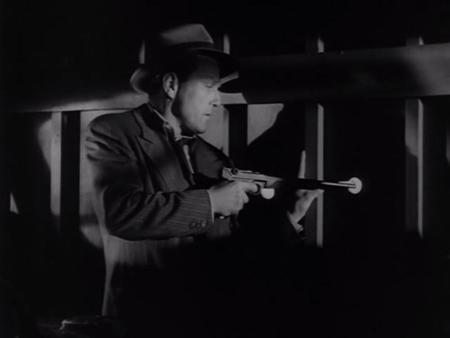
While not top-billed, and not yet a household name, the real star of the movie is without a doubt Charles McGraw. After a string of smaller parts, including a memorable part as one of the eponymous killers in 1946's 'The Killers', this movie proved to be his break-out role. It landed him a long-term contract at RKO where his next movie would be another great noir, 1950's 'Armed Car Robbery' (guess what that one's about...). As 'Red' Kluger, McGraw shows his intensity, charisma and screen presence. The man's chiseled face with his gruff voice were a perfect match for film noir. He also carries an impressive gun with an impossibly long barrel here, as can be seen in the poster as well as the screenshot below. Does anybody know the make and model of this gun? I'm curious...


As is often the case in a 'squeaky good guy versus vicious bad guy' movie, the bad guy is the one who's fascinating to watch. And McGraw, no matter what role he played, was fascinating to watch. One of noir's toughest tough guys. Director Felix Feist directed another genuine tough guy a few years earlier in another noir, Lawrence Tierney in 1947's 'The Devil Thumbs A Ride'. But while Tierney was probably the bigger (and definitely more notorious) tough guy in real life, McGraw was the better actor. And he's excellent here, elevating this movie to a higher level. He exudes menace and ruthlessness from every pore of his (in this movie extremely sweaty) body, whether it's by calmly threatening people or by getting truly violent. The few times McGraw gets violent, the camera focuses squarely on him, showing his pent-up intensity as he shoots somebody or, in the most violent scene, slams a wooden chair to bits and pieces over O'Shea whom he has pinned down on the floor.

Top-billed Michael O'Shea does a decent enough job, but to me he is not noir-material. He also appears in a few other (low budget) noirs, like 'Mr. District Attorney' (1947) and 'Parole, Inc.' (1948), but his face is far too friendly. Maybe the studios didn't know what to do with him, he never seemed to find his niche in Hollywood. But to be honest, O'Shea isn't an actor you watch a movie for, especially not something as dark as a film noir. To me he's miscast here, I cannot see how O'Shea could ever be a police detective, let alone an undercover one. Virginia Grey ('Highway 301', 'Strangers In The Night') on the other hand is great here as the gun moll. She is both desperate and seductive, and plays her part very effectively.


The movie plays out in 2 parts. The first part introduces the characters and is fast-paced. The second part starts when they get to the cabin and while the pace slows down, the tension only increases in the sweltering heat. Feist and Wild do a great job at balancing the movies parts together in a cohesive and natural manner, with a smooth but very tight flow. Also visually they keep a tight reign on things, with some excellent and clever shots, camera angles and shadows to keep things interesting.

The plot is pretty straight-forward but it does have some nice touches to it. At one point Williams, forced at gunpoint by Kruger, calls inspector Murphy over police radio to have them search in the wrong direction. He ends with a message for his wife and unborn son, using the one name he would only give his son with a gun to his back, hoping she'll catch it and inform the police. But she doesn't pick up on it until much later in the movie!


'The Threat' is a solid lean and mean slice of film noir with a lot of tension and hardly a wasted frame of film. It doesn't have a real femme fatale (altho Carol turns out to be a lethal lady), and the leading guy is nowhere near as cool as Sam Spade or Philip Marlowe. But it has Charles McGraw. And any crime movie with Charles McGraw is worth watching, take my word for it.

8/10

Fun piece of trivia: while O'Shea starred opposite McGraw in this movie which jumpstarted McGraw's career, O'Shea's wife Virginia Mayo starred opposite another silver screen tough guy, James Cagney, in 'White Heat' (also 1949) which reinvigorated his career after abandoning his gangster movies from the late 30s.

Sunday, June 21, 2015

"C"-Man (1949)

Film noir is almost by definition a style that suited the low-budget poverty row studios. It allowed for cheap sets, low-key lighting and does away with glamour. A shadow-filled world for shady characters living in seedy apartments. 1949's '"C"-Man' is an excellent example, as it's clearly a low-budget movie yet it manages to rise above its low expectations and deliver a great noir. This movie shows how a lack of budget does not mean a movie is not deserving of more attention. In fact, I'd say '"C"-Man' is kind of a hidden gem. It was the first of 3 movies produced by the short-lived Laurel Films production company, the next would be the Zachary Scott noir 'Guilty Bystander', and finally a wrestling comedy called 'Mister Universe'

Dean Jagger plays Cliff Holden, a customs agent, or "C"-man, working for the U.S. Treasury Department. His new assignment is to take over a case previously worked on by his best friend, who got killed because of it. It revolves around the theft of a valuable necklace belonging to Lydia Brundage (Edith Atwater), somewhere in France. The only lead they have is Matthew Roy (Rene Paul), who is flying back to the States soon and who they expect will smuggle the necklace back into the States. Holden is to fly to France and catch the same flight back. While waiting at the French airport, he meets Kathy Von Bourne (Lottie Elwes) who is flying to the U.S. to marry her war-time love. But on the plane Kathy is drugged by Doc Spencer (John Carradine), planting the necklace on her underneath bandages he wraps on her head, so it can be smuggled past customs. As both Holden and Kathy quickly find out Roy and his gang, including a crazy Owney Shor (Harry Landers), will literally kill for the necklace.

The movie starts off thanking people from the Treasury Department without whose help this movie apparently could not have been made. I suspect the title card was inserted to add some sort of credibility to the movie, because nothing from the sets to the story itself really point to something that required official government help.


I'm not really familiar with Dean Jagger. In this movie he seems to be channeling Dick Powell's Philip Marlowe from 'Murder, My Sweet' mostly, coming off as a second-rate version in the process. He's adequate, good even, but in terms of noir actors, he's no Powell. He would win a best supporting actor Oscar for the psychological WWII drama 'Twelve O'Clock High' the same year, but he's not as suited for this sort of darker, more cynical material as Powell turned out to be. Despite appearing in a few more noirs like 'Private Hell 36', film noir simply wasn't Jagger's best match.

Lottie Elwen was a really nice surprise, her portrayal of the Dutch Kathe van Bourne is pretty good and engaging. But according to IMDb this was her only on-screen appearance, I have no idea what happened to her, was she perhaps primarily a stage actress? In any case, it's a real shame, she had talent. Legendary character actor John Carradine, often cited as having more acting credits on IMDb than anybody else at close to 350, makes the most of his limited screen time. His alcoholic Doc Spencer is a minor character in the movie despite Carradine being billed second, but he leaves quite an impression. The same can be said for Harry Landers ('Guilty Bystander', 'Drive A Crooked Road') as the vicious and volatile Owny. He does a good job, altho he does ham it up a bit, sometimes a more restrained performance can exude more menace than a crazy one. The rest of the cast are good too, giving fairly solid performances, which help elevate the movie.

Besides the solid acting lifting this movie out from the bottom-scraping level, there are additional factors that elevate this flick. There is an unusual high amount of location shooting on the seedy streets of New York City. And it works really well here, it gives a great impression of NYC, not just in the scenes where Holden is walking across the city looking up all the liquor stores in search for information that will lead him to Doc Spencer, but also stock footage of people rushing around the Staten Island ferry terminal and such.


And then there's the music, composed and conducted by Gail Kubik. It is pretty unique and sounds way more modern than late 40s. A few years later he would win the prestigious Pulitzer Prize for his overall work. His score here plays throughout a large part of the movie, in some places it's almost a quiet muzak-like tune, but it is still there. But during key scenes his music adds a weird vibe and also provides almost horror-like sound effects, most noticably during the brutal beating of Doc Spencer by Owny. He's also responsible for the song that is played in a jazz club, which again sounds like something you'd hear in a mid to late 50s movie, not a late 40s movie.

Both director Joseph Lerner and cinematographer Gerald Hirschfeld started out with this movie, and also worked on the other 2 Laurel Films movies. Lerner's career fizzled out rather quickly but Hirschfeld stayed behind the camera well into the 90s! They both do great jobs here actually, if one manages to look through the beat up, washed out public domain print that is available online. The script by Berne Giler, who would write mostly for TV shows, is not exactly remarkable in any way, it's straight-forward and with decent but not very exciting dialogue that is clearly inspired by far better movies. But on the flipside, it means it's got a nice noir sensibility to it, that will appeal to noir lovers.

'"C"-man' is a low-budget noir and it shows. It also lacks any real star-power, an original story or anything really surprising. However, its sum is bigger than its parts. The movie as a whole, judged as film noir, works far better than expected. It rises above what it should be, and that is always a good thing. In fact, this to me is worthy to be called a hidden gem. If you love film noir, you need to check out this movie. If you're not into film noir however aside from 'the classics', this might not be your new favorite.

8/10

Saturday, May 16, 2015

Lesser-known film noir gems

Recently I got asked to contribute a list of whatever I wanted to a site called noecho.net. While the reason I got asked is music-related (I also do a blog on 90s hardcore/punk called One Path For Me Through Destiny), I decided to contribute a film noir list instead, called 'Lesser-Known Film Noir Gems', listing some films noirs that I feel deserve more recognition. I also added some quick thoughts on each choice. I would love to read other people's thoughts are on overlooked, under-appreciated noirs, so please leave a comment with your hidden gems.

Monday, April 27, 2015

Chicago Syndicate (1955)

Film noir is littered with titles referring to US cities: 'Inside Detroit', 'New York Confidential', 'Miami Exposé', 'New Orleans Uncensored', 'The Las Vegas Story' and so on. The windy city, Chicago, might top them all however in this list with 'Chicago Deadline', 'Chicago Confidential', the near-noir 'Chicago Calling', the proto-noir 'Gangs Of Chicago', and this one, 'Chicago Syndicate'. Released in 1955, it's also part of another long list of noirs, those dealing with exposing crime rackets. They became very popular after the Kefauver hearings in the early 50s, as I already mentioned in my review of 'New York Confidential'.

In this movie, Chicago's criminal top dog is Arnie Valent (Paul Stewart). By setting up countless small legitimate outfits as fronts for his less legal activities, and by using strawmen in his books, he's virtually untouchable for law enforcement. His top accountant however is ready to spill the beans to a newspaper editor, only get get gunned down by Valent's men outside the newspaper office. The newspaper editor and several city officials convene and decide they need an inside man to find something they can use on Valent. That man is Barry Amsterdam (Dennis O'Keefe), an accountant with an army background. After dropping hints he saw the hit and a talk with Valent he lands himself a job as an accountant for one of Valent's legitimate insurance firms. By first saving the company money on some big claims, and then showing Valent his top men are holding out on him, he works himself up to Valent's personal accountant. But before he can get to Valent's books, the ones with his name in them, he has to deal with Valent's girlfriend Connie (Abbe Lane) and socialite and high stakes gambler Sue Morton (Allison Hayes) who has her own reasons for wanting to get close to Valent.
'Winters said you were a bright boy.'
'I'm bright enough to be a coward where the syndicate is concerned.'
The movie's climax takes place in a tunnel system below Chicago, supposedly used for moving stock from a central warehouse to department stores around the city without having to deal with traffic. It's short but sweet, altho not coming close to similar and more memorable underground/tunnel scenes like those from 'He Walked By Night' and 'The Third Man'. But for a B-movie which this clearly is, it's really well-done.

Dennis O'Keefe is best known in noir circles for his lead roles in the Anthony Mann/John Alton noirs 'Raw Deal' & 'T-Men'. He appeared in a ton of noirs tho, mostly for B-studios. In some ways he always reminds me of a poor man's Alan Ladd, and like Ladd, he's perfect for film noir. He has the right look and stoic expressionless face. His Barry Amsterdam doesn't take the inside job out of a sense of duty or injustice, the only reason he's interested is the $60K reward that the group is offering him, so he can start up his own accounting firm. A nice touch, which helps set this movie apart from the usual breed of 'brave' men in these movies. His adversary here, Paul Stewart, was an accomplished actor, both on the screen and in radio, having paid his dues in Orson Welles's Mercury Group. Like O'Keefe he appeared in many noirs, such as 'Champion' and 'Kiss Me Deadly'. He is great here, giving a sophisticated edge to Valent, while also showing Valent to be from the streets when he visits his mother in one of Chicago's lower class districts with Amsterdam.


Allison Hayes plays a tricky role here, as Sue Morton is only an alias, she's really somebody else. That reveal comes at the halfway point of the movie, both for Barry Amsterdam and the viewer. It adds an extra plotline to the movie, and Hayes pulls it off well. I also liked that her character and Amsterdam have obvious chemistry, but don't really do anything about it, they're both 'all business' in a sense. Contrast that with Abbe Lane's Connie, who is only about one thing, her relationship with Valent and more importantly, everything that comes with it. She's jealous and suspicious, trusting nobody except Valent and her bandleader, played by Lane's husband Xavier Cugat. Cugat was a bandleader in real life, he and his orchestra appeared in several movies, primarily those with Lane in them. They also do a few musical numbers here, with Abbe Lane singing, she's not dubbed as was often the case in these noirs. Lane does an nice job of portraying a beautiful and jealous woman, including a scene where Connie and Sue exchange catty remarks back and forth before enaging in a catfight.
'Everything gets better with age... except women.'
The names behind the camera are far more obscure. Director Fred F. Sears did direct several of the city noirs mentioned before, together with one half of this movie's duo of cinematographers, Henry Freulich. The other half, Fred Jackman Jr. lensed B-noirs like 'The Night Holds Terror' and 'They Made Me A Killer'. They managed to give the movie a decent, if unimaginative, look. The writers were also fairly undistinguished, Joseph Hoffman and William Sackheim. The crew does show what experience and workmanship can accomplish, as this is by no means a bad movie, it is well-paced and well-made.


As per usual, the movie ends with voice-over narration. But unlike most of these crime-busting noirs, the words spoken are not of the patronizing 'The brave government agents saved the day, order has been restored, you can sleep safely at night again.' sort, but more cynical, as it also implies that everybody, not just law enforcement agents, but also the general public needs to stay on their toes to keep the syndicate from rising up again. A nice touch to an above-average movie. 'Chicago Syndicate' is no classic by any standard, but it's well worth the effort.

7/10

Tuesday, December 2, 2014

Fall Guy (1947)

Cornell Woolrich's novels and short stories were a rich source of inspiration for films noirs and beyond. Noirs like 'Black Angel', 'The Chase', 'Fear In The Night' and 'Phantom Lady' but also the Hitchcock classic 'Rear Window' were all based on his writings. 1947's 'Fall Guy' was based on his short story 'Cocaine' which first appeared in the legendary pulp magazine Black Mask in 1940 under the title 'C-Jag', and was also published in other magazines under the titles 'Dream Of Death' and 'Just Enough To Cover A Thumbnail'.

Director Reginald Le Borg and cinematographer Mack Stengler don't have a lot of noir credentials under their belt, they worked mainly on quick programmers for the lower end of a double bill. Stengler did work on another Woolrich adaptation tho, 1948's film noir 'I Wouldn't Be In Your Shoes'. First time producer Walter Mirisch would later, together with his brothers, produce several classic movies like 'Some Like It Hot' and 'West Side Story'!

Tom Cochrane (Leo Penn, credited as Clifford Penn) is the 'fall guy' here. One night he passes out in a dark alley, with someone else's blood all over his clothes and his pocket knife. In hospital the next morning, police inspector Shannon (Douglas Fowley) is asking him what happened and who the victim is. Cochrane decides to escape rather than get arrested there and then. He manages to convince his fiancee Lois (Teala Loring) and his brother-in-law Mac McLaine (Robert Armstrong) that he's innocent even if he has only a vague recollection of what happened. He remembers getting dragged to a party by an elevator jockey called Joe (Elisha Cook Jr.), whom he just met that evening. At the party torch singer Marie (Virginia Dale) slipped him what must've been a spiked drink... After he woke up, he found the dead body of a girl in a closet in the apartment. Barely able to stand up, he managed to go outside before collapsing in the alley... Mac, who's a cop, decides he wants to help Cochrane find out the truth before turning him in. Together they go in search of the apartment, Joe, and Marie...


I was not really aware of Leo Penn (credited as 'Clifford Penn' here) before watching this movie, and I can't say I was impressed by his acting in this movie. 'Lightweight' seems to be the right word to describe him. At no point does he convince or seem terribly upset with the predicament he's supposed to face. Penn would quickly move on to work in TV, both as an actor as well as a director. As an interesting sidenote, he's the father of more famous actors Sean & Chris Penn.

Teala Loring comes off as a 'B' version of Rita Hayworth in the looks department, which is not a bad thing at all! She is also pretty decent in this movie acting-wise altho her part as Tom's fiancee is fairly limited. 'Fall Guy' was one of her final movies before retiring from acting, her credentials include such B's as 'Bluebeard' and the Charlie Chan vehicle 'Dark Alibi'. In 'Fall Guy' she lives in with her uncle Jim while waiting for Tom to make up his mind about their marriage and future life. Uncle Jim is played by Charles Arnt, a very familiar face in dozens of 40s movies including noirs like 'The Man Who Cheated Himself', 'Strange Illusion' and 'Hollow Triumph'.
- I take trips in my dreams too, but I don't call it killing!
- Yeah but you don't wake up with blood on your clothes... on your hands... on your knife.
Robert Armstrong is good enough as the grumpy but steadfast brother-in-law. However, whoever cast Armstrong forgot that this 50-something year old actor, with his rugged face and grey hair that made him look even older, was supposed to play a 36-year old man, as shown in a newspaper article halfway through the movie! Not that I have a problem with Armstrong, he's fine, but it makes you wonder if the casting director even looked at the script. Also watch closely as Mac, with Cochrane and Lois, drive away from a cinema. The marquee of the theater shows it's playing a double bill consisting of 'Decoy' and an unnamed 2nd movie. 'Decoy' is a wacky, unique film noir from 1946, with Robert Armstrong as a criminal who dies in the gas chamber and is then brought back to life again!

Saving the best for last, noir favorite Elisha Cook Jr. is far and away the biggest name in this movie. He is his usual solid self, but he doesn't have to do a whole lot here. It's one of the unwritten laws of film noir that Elisha Cook Jr. does not make it to the end of a noir alive or victorious. This noir is no different! And that's not giving away too much. Either way, it's always a pleasure to see him turn up in a noir.


Despite the obvious low budget for the movie, production company Monogram Pictures wasn't one of the so-called Poverty Row film companies for no reason, the movie looks fairly decent, also by cleverly mixing in quite a bit of stock footage for the sequences showing Mac and Cochrane walking all over NYC to find clues. In an unintentionally funny instance tho, there's a birds eye view of a NYC street at night that clearly freezes for a second or so, cars stopping all at the exact same moment, before dissolving into the next shot. Sets are also recycled, interior sets doubling for several apartments and such. But this is most painfully obvious when several entrances to subway stations all look exactly the same, except for a banner hanging above the entrance with a different street number. Chances are all those scenes were shot in a single afternoon as well.
Then I saw the singer, she wasn't bad-looking. You might not give her a second thought, but you'd look twice.
The movie starts out quite decent, with an intriguing set-up. But the middle part with Mac and Cochrane wandering around NYC and a too-long semi-comedic segment where they're questioning the owners of what they think is the apartment where the party was, almost feel like filler even if it's decently done. Things pick up again for the last third of the movie with a few minor twists. The final reveal however comes almost completely out of left-field, hats off to anyone who saw that one coming. I have no idea if this was also lifted from Woolrich's story, but it's more of a 'hmmm' ending than a real 'wowza' twist. So after the promising start, the movie doesn't quite live up to it afterwards. It also doesn't quite have the dark noir look either, apart from a few spots here and there. But at least it moves along at a fast pace, which is pretty much the main requirement for these types of cheap programmers. It's worthy of a watch if you're into these cheapo B's, it has its charms, but if you're looking for a good Woolrich adaptation, look elsewhere.

6/10